Tag Archives: prophecy

In What Sense Does Prophecy Continue Today? – Part Three

The prophetic office has ceased while the gift continues as prophetic preaching. In the previous posts I demonstrated from Scripture the temporary nature of the prophetic office by recourse to three categories of biblical data.

  • Prophets appeared at periodic intervals in history—never continuously.
  • The inspired revelations God gave them were rarely predictive. God used them to speak his message to people in specific historical situations.
  • Prophecies were authenticated both by their perfect accuracy and by signs, wonders and miracles. Any predictions they brought had to be 100% accurate or be declared false.

The church is “built on the foundation of the apostles and prophets with Christ himself as the chief cornerstone” (Eph. 2:20). The inspired prophetic office has ceased just as the apostolic office has ceased. Revelation in complete. There is no further need for inspired prophets but as a non-inspired ministry gift it continues. Why do I say that? Four categories of evidence lead me to this conclusion.

  1. PROPHETS AS PREACHERS 

God chose Moses, Isaiah, and John the Baptizer to not only communicate inspired revelation,-he also gifted them to preach the Word with power. The Greek word for prophecy means simply to make public utterance or to speak out.

Moses spoke to Israelites groaning under Egyptian bondage. Isaiah preached to a nation in declension. Paul appealed to a Corinthian church in disarray due to scandals. The relevance of their messages to particular situations, rendered their preaching memorable to their audiences. Besides these through whom God gave us inspired Scripture, the New Testament mentions other prophets.

The five men, including Barnabas and Saul, who gathered to worship God in Acts thirteen, are called, “prophets and teachers.” The text denotes either that there were at least two prophets, or that all five had both the gift of teaching and that of prophecy. I prefer this latter view. (Acts 13:1) 

In Antioch we read, “Judas and Silas, who themselves were prophets, said much to encourage and strengthen the brothers.” (Acts 15:32) Of Paul and Barnabas we read, “But Paul and Barnabas remained in Antioch, where they and many others taught and preached the word of the Lord.” (verse 35) We conclude that a prophetic ministry involves preaching and teaching. These references multiply the number of prophets far beyond those few who gave us our inspired Scriptures. Other references abound. At least one prophet attended Timothy’s commissioning. (1 Tim. 4:14) Several must have been present in Ephesus. (Eph. 4)

First Corinthians contains an extended description of the gift and how it contrasts with tongues. (Chapter 14)  “Two or three prophets should speak, and the others should weigh carefully what is said.” (1 Cor. 14:29) If we count both participating prophets and evaluating prophets there must have been between five and ten in Corinth. Paul indicates that a considerable number of men with the gift of prophecy took turns speaking to the Corinthian church. “You can all prophecy in turn so that everyone may be instructed and encouraged.” (vs. 31) New Testament texts, then, specifically mention prophets in Jerusalem, Antioch, Corinth and Ephesus. One quickly gains the impression that prophets commonly ministered in the early churches, functioning as preacher/teachers.

B. EXHORTATIONS TO SEEK THE GIFT OF PROPHECY   

If God had reserved the gift of prophecy exclusively for those he chose to lay the foundation of the church, we would not find a general exhortation to seek the gift. We read, however, “Eagerly desire the greater gifts.” One of the greatest is prophecy. Paul specifically states, “Desire spiritual gifts, especially the gift of prophecy, . . . . I would rather have you prophesy . . . . Be eager to prophesy.” (12:31; 14:1,5,39)

These exhortations would be meaningless unless meant to encourage, not only the Corinthians, but believers today to seek the gift. To deny this is to empty the epistles of their relevance.

Each of the three main New Testament gift lists mentions the gift of prophecy. (See Romans 12:6-8, 1 Cor. 12:7-11, Eph. 4:11-13) Only the gift of teaching is mentioned as consistently. This frequency of mention, in epistles of both early and late origin, shows that its use is crucial. Prophecy is one of the five key equipping gifts in Ephesians chapter four. Prophets join apostles, evangelists, pastors and teachers as men given to “prepare God’s people for works of service so that the body of Christ may be built up” (vs. 12).  Since equipping for service is a continuing need in all churches, the mention of these five gifts, including prophecy,  indicates that in some sense these gifts continue. (In other material I explain my view that while the office of inspired apostles ceased—there were only 12—the gift as missionary church planting continues. Church— No Spectator Sport, Chapter 9.)

C. DETAILED DESCRIPTION OF THE PROPHETIC GIFT   

First Corinthians, chapters twelve through fourteen gives a detailed description of the gift of prophecy. In the course of pointing out the necessity of love in gift exercise Paul writes, “If I have the gift of prophecy and can fathom all mysteries and all knowledge, . . . but have not love I am nothing.” (13:2) This text shows that prophecy deals with fathoming mysteries and knowledge.

In the fourteenth chapter Paul establishes the superiority of prophecy over tongues. In verse three and four we read, “Everyone who prophesies speaks to men for their strengthening, encouragement and comfort . . . . He who prophesies edifies the church.” The gift builds up the church by applying God’s Word to people’s specific needs. They strengthen those who are weak. They encourage the discouraged. They comfort the sorrowing. Non-inspired modern prophets mirror the ministry of the inspired prophets of old. God specifically gifts them to apply the Word to particular situations in their churches.

Further we read, “Prophecy, however, is for believers.” Prophecy is exercised so that, “Everyone may be instructed and encouraged” (vs 32).  Of course, prophecy also profoundly affects unbelievers, in a way tongues cannot. The unbeliever, hearing tongues speaking, thinks “that you are out your mind.” (vs. 23) But when an unbeliever hears prophesying, “He will be convinced by all that he is a sinner . . . secrets of his heart will be laid bare. So he will fall down and worship God exclaiming, ‘God is really among you.'” (vs. 24,25) While the gift of prophecy is mainly directed towards believers, God also uses it to bring unbelievers under deep conviction.

Available through Amazon

We can define prophecy, in its continuing form, as follows.

The gift of prophecy is that spiritual ability to communicate biblical truth in powerful and relevant ways so that people sense a word from God directed to them in their situation. It is Spirit-filled preaching that may include instruction, encouragement, exhortation, or comfort.

Note the difference between inspired prophecy and edifying prophecy. Inspired prophecies have an unbidden, Spirit-produced element to them as if the Spirit overrides the will of the prophet. “For prophecy never had its origin in the will of man, but men spoke from God as they were carried along by the Holy Spirit” (2 Peter 1:21). But Paul describes the gift of prophecy in the church as orderly and controlled. “The spirits of the prophets are subject to the control of the prophets” (1 Cor. 14:32) Prophecy, in this form, involves orderly presentations of truth which flow from the speaker’s mind and will. This text seems to demonstrate a discontinuity between inspired prophecy and, what I am calling edifying prophecy, which owes its origin (under the Spirit’s general guidance) to the speakers’ own personality and preparation.

Inspiration is evidence of the absolute superintendence by the Spirit, while illumination is evidence of the relative control by the Spirit. A picture of two kinds of prophecy emerges; inspired prophecy that produced the inerrant canon of Holy Scripture (and occasionally included prediction) and prophecy as convicting and edifying preaching. Prophetic preaching draws its power from a broadly based acquaintance with Scripture and ongoing dependence on the Spirit. It includes the ability to size up situations and needs and bring a relevant message. Prophetic preaching leads to conviction, consolation, rebuke, or encouragement. Prophecy, as a continuing gift, requires the illumination of the Spirit but not the inspiration of the Spirit.

The gift of prophecy is preaching. Paul exhorts Timothy to “Preach the Word; be prepared in season and out of season; correct, rebuke and encourage — with great patience and careful instruction” (2 Tim. 4:2).

When any Christian group claims divine authority for one of their pronouncements, they invite disaster. History is littered with the heretical wreckage produced by this propensity to claim divine inspiration for human messages or practices. No wonder, traditional Pentecostals react with alarm to the claims of modern “prophets.” The General Superintendent of the Assemblies of God wrote, “Arbitrary and absolute direction by a prophetic gift is not in accordance with New Testament teaching . . . . A study of church history indicates that every group of people who have claimed to restore apostolic authority to the Church and its government have been arbitrary and demanding. Those who come under their leadership find themselves under bondage.”[i]

D. PROPHECY AS VIEWED IN CHURCH HISTORY. 

Flynn writes, “The Early Church had many prophets, who usually employed their gift in their own local congregation. Some eminent prophets itinerated. The Didache, an early manual of church practice, commanded that wandering prophets be supported. ‘Every true prophet who shall settle among you is worthy of his support.'”[ii]

What an intriguing tradition! This stipulation of the Didache demonstrates that although the canon was complete, the early church believed in the continuity of a prophetic ministry. It presents these early prophets as resident preachers. Interestingly, this reference points out a fundamental difference between apostles and prophets. The Didache warned that apostles, (since their ministry was pioneer church planting) should not be supported over a long period. Prophets, however, could be supported as resident ministers because they laboured to edify already established churches.

Calvin gives his view. “By prophesying I do not understand the gift of foretelling the future, but the science of interpreting Scriptures, so a prophet is an interpreter of the will of God.”[iii] Interpretation of the will of God underscores a preacher’s need to size up a situation and then bring relevant Scripture to bear on the central issues involved.

Berkhof, Criswell and many others could be quoted in this regard. J.I. Packer sums it up: “Rather than supposing prophecy to be a long-gone first-century charisma now revived and therefore to be dressed up in verbal clothes that will set it apart from all other forms of Christian communication over the past eighteen or nineteen centuries, we should realize that it has actually been exhibited in every sermon or informal ‘message’ that has had a heart-searching, home-coming’ application in its hearers, ever since the church began. Prophecy has been and remains a reality whenever and wherever Bible truth is genuinely preached–that is, spelled out and applied, whether from a pulpit or more informally. Preaching is teaching God’s revealed truth with application.[iv] (Italics mine.)

The kingdom needs preaching prophets today as never before! “History tells of no significant church growth and expansion that has taken place without preaching (significant, implying virility and staying power is the key word there.) What history points to, rather, is that all movements of revival, reformation, and missionary outreach seem to have had preaching (vigorous, though on occasion very informal) at their center, instructing, energizing, sometime purging and re-directing and often spearheading the whole movement. It would seem, then, that preaching is always necessary for a proper sense of mission to be evoked and sustained anywhere in the church.”[v]

The gift of prophecy, in its continuing form, is heart- searching, applicational preaching deeply rooted in biblical exposition. Paul encourages us to aspire to great gifts such as this one. If you find such a desire burning within take steps to feed the flame by taking appropriate action. I have listed in the footnote the titles of some good books on preaching.[vi]

Let us all pray for a revival of powerful preaching!


[i] Carlson, pp. 23, 24

[ii] Flynn, p. 53

[iii] Ibid, p. 52

[iv] Packer, Keep in Step with the Spirit, p. 217

[v] J. I. Packer, The Preacher and Preaching, Samuel T. Logan, ed., Phillipsburg, N.J.: Presbyterina and Reformed, 1986, p. 21

[vi] Books on Preaching.

            -W. E. Sangster, The Craft of Sermon Construction and Illustration, Grand Rapids: Baker, reprint 1984

-John A Broadus, On the Preparation and Delivery of Sermons, New York: Harper, many editions, my edition 1943

-Haddon Robinson, Biblical Preaching, Grand Rapids: BAker, 1980 (8th printing-May 1983)

-D. Martyn Lloyd Jones, Preaching & Preachers, Grand Rapids: Zondervan, 1971

-Samuel Logan Jr., ed., The Preacher and Preaching, Phillipsburg, N.J.: Presbyterian and Reformed, 1986

-Sidney Greidanus, The Modern Preacher and the Ancient Text, Grand Rapids: Eerdmans, 1988

(Let me know your thoughts on this subject. If you appreciate this blog, please pass it on. If I can help you spiritually, let me know. Further articles, books, and stories at:  Facebook: Eric E Wright Twitter: @EricEWright1 LinkedIn: Eric Wright ; Eric’s books are available at: https://www.amazon.com/Eric-E.-Wright/e/B00355HPKK%3Fref=dbs_a_mng_rwt_scns_share)

Does the Gift of Prophecy Continue Today? – Part Two

Confusion about the continuity or completion of the prophetic office prevails among Christians today. The Church is “built on the foundation of the apostles and prophets, with Christ Jesus himself as the chief cornerstone” (Eph. 2:20). Since there were only twelve founding apostles, it is reasonable to suppose that the number of inspired prophets was also limited. Let’s look at what the Bible says about prophets.

First, prophets were not present throughout the whole OT period. Certainly, all Old Testament Scripture is prophetic in nature. Christ declared, “All the prophets and the law prophesied until John (the Baptist),” indicating that even the Law was prophetic. (Matt. 11:13) Further, Peter writes, “No prophecy of Scripture . . . was ever made by an act of human will, but men moved by the Holy Spirit spoke from God” (2 Peter 1:21).

God revealed Old Testament Scripture at widely spaced intervals; not in a continuous process. “In the past God spoke to our forefathers through the prophets at many times and in various ways” (Heb. 1:1). Periods of revelation were interspersed with long periods of prophetic silence. Moses, recipient of the Law was the first major prophet. “Since then, no prophet has risen in Israel like Moses, whom the Lord knew face to face” (Deut. 34:10).

Prophets were not present during the period of the Judges and Joshua. Vision was rare. (See 1 Sam. 3:1) Finally, Samuel arose to take up the prophetic mantle. Through the kingdom period which followed the era of Samuel, as priests became increasingly corrupt, prophets as God’s voice became more common. Elijah and Elisha prophesied during this period. God raised up the schools of the prophets to compensate for priestly failure. Prophets of this era, however, did not add to the inspired literature that became Holy Scripture.

The golden period of prophetic greatness extended for about four hundred years, from approximately 800 BC. to 400 BC. During this era prophets such as Isaiah, Jeremiah, Ezekiel and Daniel, produced major works. Others, such as Amos, Hosea, and Malachi, contributed powerful, but short prophetic collections.

Malachi, the last of the Old Testament writing prophets, ushered in four hundred years of prophetic silence until the rise of John, the Baptizer, who introduced Christ. Jesus, as prophet, priest, and king shepherded a new prophetic era which produced the New Testament canon.

Secondly, biblical prophets were inspired vessels used by God to convey messages which usually became books of the Bible. Their messages were God-breathed—inspired. “For prophecy never had its origin in the will of man, but men spoke from God as they were carried along by the Holy Spirit” (2 Peter 5:21). Peter explains, “No prophecy of Scripture came about by the prophet’s own interpretation” (2 Peter 5:20). Hebrews reminds us that, “God spoke to our forefathers through the prophets” (Heb. 1:1). Prophecy in this sense is synonymous with revelation. Paul reminds us that the mystery of Christ and the church, “which was not made known unto men in other generations . . . . Has now been revealed by the Spirit to God’s holy apostles and prophets” (Eph. 3:5). That era has ended.

Surely, no self-proclaimed modern prophet would claim that their messages are an addition to Scripture! Note how emphatically Paul links his prophetic and apostolic credentials to his reception of revelation. “I want you to know, brothers, that the gospel I preach is not something that man made up. I did not receive it from any man, nor was I taught it; rather, I received it by revelation from Jesus Christ” (Gal. 1:11,12). In this inspired sense, the office of prophets has ceased. The Bible is complete.

Although traditional Pentecostals believe that the prophetic office continues in some sense in our day, they express alarm at many of the claims of modern prophets. Raymond Carlson–General Superintendent of the Assemblies of God–warns; “Prophecy by the New Testament apostles was different in authority from that of all other Christians in local churches. The writings of the New Testament are God’s very words . . . . No words spoken today can ever be on a par with the inerrant Scriptures.”[i]

Thirdly, we must distinguish between prediction and preaching in prophetic ministry. On the whole, prophets were not predictors–foretellers–but rather forthtellers, preachers. Moses and John the Baptizer, two of the greatest prophets of all time, recorded little or no prediction. With minor exceptions, the entire content of Moses’ prophetic ministry was either history, ethical statements (law), or exhortations for Israel to heed God’s directives. He did warn them about the consequences of disobeying the law and he did predict that there would be another prophet raised up like him.

In the main, prophets were forthtellers, preachers, appointed by God to herald his Word in a particular context. Consider Moses. God told him, “Now go; I will help you speak and will teach you what to say.” (Ex. 4:12) Moses went with a message from God. Likewise, God commanded Isaiah to, “Go and tellthis people” (Is. 6:9ff).

In a similar way, the prophetic ministry of the apostles contained a minimal of prediction.  They spoke to specific needs in concrete situations. The gospels and epistles each appeal to different audiences. Even the most predictive of books, Revelation, brought a message from God to the seven churches of Asia in specific historical situations.

To cry out for a return of the prophetic office out of a desire to listen to predictions, is to demand something of the prophetic office that, even in its heyday, it rarely exhibited. They were great preachers presenting truth. Jesus predicted that the Spirit would lead the apostles into all truth. Did he or did he not? Is the Bible complete or flawed? If he did what he predicted he would do, we have no further need of new revelations.

Paul wrote to Timothy that Scripture contains all the truth necessary for any Christian to be mature and complete in Christ. (See 2 Tim. 3:15-17.) Why this continual clamour for prophets to bring a “revelation,” a “word from God,” a “prediction” when the Scriptures contain the adequate, all-encompassing, and inerrant revelation of God’s will for mankind? To demand the revival of the gift of prophecy, as manifest in biblical prophets, is to devalue the Scriptures, and to encourage the manufacture of counterfeit miracles to verify these modern ‘prophets’.

Fourthly, prophecy must be tested by Scripture and any prediction prove to be 100% accurate. Superficially, many claim that miraculous signs attest their own ministry’s authenticity. We need to remember that the magic of the Egyptian magicians initially mimicked the signs Moses performed. In India, Hindu, Sikh and Buddhist gurus echo Muslim pirs in claiming power to effect miraculous cures. Some even demonstrate their power by walking on fire. But the Bible warns, “Dear friends, do not believe every spirit, but test the spirits whether they are from God, because many false prophets have gone out into the world” (1 John 4:1).

Testing a prophet requires a carefully comparison of their teaching with Scripture. John urges the readers of his first epistle to check whether a prophet’s teaching enshrined or denied the reality of Jesus’ incarnation and deity. (1 John 4:2,3) Much earlier God had warned Moses not to be impressed by miraculous signs but to check the content. “If a prophet . . . appears among you and announces to you a miraculous sign or wonder, and if the sign or wonder . . . takes place, and he says, ‘Let us worship other gods,’ you must not listen” (Deut. 13:1-3). Conformity to revealed truth takes precedence over startling manifestations of signs.

Prophetic prediction must not only be true to Scripture but perfectly accurate. Since God can predict the future with 100% accuracy, any prophecy of his, will come true. An accuracy rate less than 100% necessarily shows that the bearer’s prediction did not originate with God. “If what a prophet proclaims in the name of the Lord does not take place or come true, that message the Lord has not spoken. That prophet has spoken presumptuously” (Deut. 18:22). A failed prophecy called for the perpetrator to be sentenced to death. All New Testament prophecy practiced in the early church passed this litmus test. (See Acts 11:27,28; 21:10,11) Perfect accuracy confirms a prophet’s credentials.

Sadly, many who claim the prophetic gift today, excuse inaccuracy. Several years ago Michael G. Maudlin set out to investigate the excitement generated by reports of the predictions of “The Kansas City Prophets. He wrote; “These men–pastor Mike Bickle, and prophets such as Bob Jones, John Paul Jackson, and Paul Cain are creating a stir in charismatic circles. They claim that the prophetic gift should be restored in the church, that prophecy is a natural, biblical means for God to speak to his people, and that (here’s the apocalyptic part) this increased prophetic activity is a sign of the emergence of the last-days’ victorious church.”[ii] The Kansas City Fellowship joined the Vineyard group of churches under John Wimber, who encouraged believers to seek the gift of prophecy.[iii]

The stir created by Vineyard and KCF moved traditional Pentecostals to issue cautionary statements. Indeed, the Vineyard itself has delineated a series of checks and balances to test prophecy. “All KCF and Vineyard leaders stress that the prophetic movement is immature and apt to make mistakes (except for, they stress, Paul Cain) . . . . The church allows for a generous margin of error in prophetic words . . . . Grudem, who teaches theology at Trinity Evangelical Divinity School and attends a Vineyard-affiliated church, argues that every prophet today will make mistakes.”[iv]

Grudem claims that, “The Old Testament prophets who could not make mistakes without being declared false and put to death . . . in the New Testament are not prophets but apostles . . . . There is a discontinuity between the canonical revelation found in the Bible and the revelation received by modern-day prophets.” But as Robert Thomas, who teaches New Testament at California’s Master’s Seminary says, “How can you have inspired utterance that has error?”[v]

The Vineyard magazine, Equipping, contained a series of articles introducing prophetic ministry. In article after article the magazine attested to the veracity of the revelations that God has given this man and that. In the same breath it warns that prophets make mistakes. “Of course, prophets today do receive revelations from God. But in understanding and reporting what they receive, and in knowing what is from God and what is from their own minds or from a subtle suggestion of the Enemy, prophets do make mistakes . . . . Every prophet today will make mistakes.”[vi]

Sorry, the Bible is clear. Prophets must be 100% accurate or be declared false.

To review: 1. Prophets appeared at periodic intervals in history. 2. God called them to speak and write what he revealed to them. These revelations were rarely predictive. In the main they contained God’s Word for specific historical situations. Prophets were mainly powerful preachers. 3. Predictive prophecies were authenticated by their perfect accuracy.

Much more could be discussed on this topic. Having asserted that inspired prophecy as a gift or office has ceased, I am not saying that prophetic gifting does not continue in the New Testament Church as prophetic preaching. Uninspired prophecy continues as a preaching and teaching gift requiring the exegesis of the biblical text. Today’s prophetic preachers do not claim inspiration but use the inspired text of the Bible as their source. For a fuller treatment of this subject see my book Church-No Spectator Sport available through Amazon. Time permitting, I’ll write a third post in this series describing the limited sense in which the gift of prophecy continues. Of course, none of the above is written to limit God. As he used Agabus to predict a famine and warn Paul (see Acts 11:27,28; 21:10,11), he can at any time raise up a predictive prophet. However, such a rare occurrence must be discerned by Scripture. God is sovereign. May he be glorified in the church through the exegesis of his inspired Word.


[i] G. Raymond Carlson, The Role of the Prophet Today, Article in The Pentecostal Testimony, March 1991, p. 22

[ii] Michael G. Maudlin, Seers in the Heartland, Article in Christianity Today, Jan. 14, 1991, p. 18

[iii] John Wimber, Introducing Prophetic Ministry, Article in Equipping, Fall 1989, pp. 4-6

[iv]  Maudlin, p. 20

[v] Ibid

[vi] Wayne A. Grudem, What Should be the Relationship Between  Prophet & Pastor? Article in Equipping, Fall 1989, p. 8

(Let me know your thoughts on this subject. If you appreciate this blog, please pass it on. If I can help you spiritually, let me know. Further articles, books, and stories at:  Facebook: Eric E Wright Twitter: @EricEWright1 LinkedIn: Eric Wright ; Eric’s books are available at: https://www.amazon.com/Eric-E.-Wright/e/B00355HPKK%3Fref=dbs_a_mng_rwt_scns_share) See especially, Doctrine in Denim.

Does the Gift of Prophecy Exist Today? – Part One

Whether seeking to read the entrails of animals or interpret the stars, mankind has always aspired to the prophetic gift. A yearning to slay fear of an unknown future has energized this search down through the centuries.

The quest for this mystical gift continues today–often dressed up in pseudo-scientific jargon. An article about the work of Dr. Kary Mullis, a California molecular biologist, reports his assertion that, “Genes can ‘see’ child’s future.” Dr. Mullis predicts that in ten years we will be able to read a child’s whole future within a few hours of birth. He claims that the DNA in a single cell contains “everything about the child.”[i] According to Dr. Mullis, all we wait for is the technology to read the future as already encoded in the DNA.

Jean Dixon has been making predictions for years. She supposedly foretold the assassination of John F. Kennedy four years before he was elected President, the death by airplane crash of Dag Hammerskjold as well as the Communist takeover of China. But in a CBC radio show, the Great Randy (Mr. James Randy) talked about the research of the National Inquirer into 364 of her prophecies. They found that only four had come true. The quality of these four was of the order of, for instance, there will be a “great medical breakthrough this year,” and “there will be a scandal in Hollywood this year.”[ii]

Some modern evangelicals seem to hunger after prophecy. A sincere young man in a congregation I was pastoring startled me by claiming that I was hindering the Spirit by not encouraging prophecy. Quoting from First Thessalonians, “Do not put out the Spirit’s fire, do not treat prophecies with contempt,” he explained that I was hindering the Spirit by discouraging “a word of prophecy.”  Fortunately discussion and prayer led this young man to moderate his evaluation. But the pressure to seek a fresh and “authentic” word from God in the form of “a word of prophecy,” continues to increase.

Pentecostal and charismatic circles, particularly, face this challenge. Let me say at the outset that I view most charismatics as fellow evangelicals. J.I. Packer spent considerable time seeking to ascertain just what charismatics meant by prophecy. He  concluded: “By prophecy I mean the receiving and relaying of what purports to be a divine message. Prophecy is a regular feature of charismatic fellowship. The usual beliefs about it are (1) that it is a direct revelation from God of thoughts in his mind, which otherwise would not be known; (2) that it frequently includes specific directions by God, concerning his plans for the future; (3) that its proper verbal form is that of Old Testament oracles, in which the one who speaks is regularly God himself; and (4) that it was a sign gift in the apostolic church, which, with the other sign gifts, was in abeyance in the church from the mid-patristic era till the twentieth century. But all of this is doubtful.”[iii]

Most of our charismatic friends believe that God continues to issue revelations. However, belief that God has continued to reveal himself in prophecy has been rarely held in church history. It has been confined mainly to the fringes of orthodox faith. The term Quakers use for continuing revelation is inner light. George Fox, founder of Quakerism, taught that Christ continues to bring revelations directly to the hearts of his people.[iv]

Throughout history consensus about prophecy and revelation has ruled the theology of main-line Christians. The vast majority agreed that the gift of prophecy is NOT an endowment through which God inspires new revelations. This unanimity has generally continued among traditional evangelicals and reformed believers.

There consensus ceases and a variety of opinions proliferates. Does the gift of prophecy continue in any sense? Calvin believed that prophecy continues, not as ability to foretell the future, “But the science of interpreting Scriptures, so that a prophet is an interpreter of the Will of God.”[v]

LEAD Technologies Inc. V1.01

C.H. Spurgeon, on the other hand, believed that the gift ceased. In his view prophets occupied a peculiar office. They served as “link between the glories of the Old and New Testament.”[vi] J.I. Packer believes that prophecy as revelation has ceased but that the prophetic ministry continues in prophetic preaching.[vii]

Modern confusion about prophetic revelations, has even spread to reformed circles. Anthony Coppin writes about attendance at a Reformed and Renewed Pastor’s Conference in Hertfordshire, England in an article, “Life in the Spirit.” He was obviously taken aback by the charismatic practices and beliefs he saw there. He reports that Bernard Thompson, one of the leaders of the conference, describes prophecy as, “startling and a little frightening. We can,” he tells us, “claim inspiration but not inerrance for words of revelation which Spirit-baptized believers bring!”[viii]

This confusing new definition of inspiration and revelation departs violently from the traditional view. Traditionally, (upon solid biblical grounds) revelation has been considered inerrant. How could a product of the inspiration of the Holy Spirit be otherwise? It is unthinkable to attribute error to a process that owes its origin to the superintendence of the perfect God!

All around us fuzzy theological thought is blurring the definitions crystallized after centuries of painstaking biblical research. Christians talk of words of knowledge, prophecies and revelations. They invest these communications with divine authority. They charge those who refuse to acknowledge the authority of these declarations with hindering the Spirit. Those who bring “prophecies” assert that they have the same weight as Scripture because God is their author. On the other hand, as we will see in the next instalment, the proponents of modern day prophecies admit their fallibility. But how can any believer attribute fallibility to a direct word from God? A fuzzy understanding of the implications of these claims pervades the modern charismatic movement, particularly those in the third wave. (The third wave is a term popularized by John Wimber and the Vineyard movement. In their view, the first wave was traditional Pentecostalism, the second, the charismatic movement and the third is a more moderate and generally evangelical movement.)

We face, then, great diversity of opinion about the gift of prophecy. I’ll seek to harmonize Scripture on this gift in the next segment. [Excerpted from Church No Spectator Sport available from Amazon.]

(Let me know your thoughts on this subject. If you appreciate this blog, please pass it on. If I can help you spiritually, let me know. Further articles, books, and stories at:  Facebook: Eric E Wright Twitter: @EricEWright1 LinkedIn: Eric Wright ; Eric’s books are available at: https://www.amazon.com/Eric-E.-Wright/e/B00355HPKK%3Fref=dbs_a_mng_rwt_scns_share)


[i] Marilyn Dunlop, Article, Toronto Star, May 2, 1987

[ii] Radio Program, Canadian Broadcasting Corporation, Toronto, May 29, 1987

[iii] J.I. Packer, Keep In Step With The Spirit, Old Tappan, N.J.: Fleming H. Revell, 1984, p. 215

[iv] George Fox,”Christ is come to teach his people himself,” Christopher Rule writes that; “Fox sometimes seemed to think himself infallible . . . . He advised a woman not to tell Parliament that the King would be restored, but seemed to have accepted it as true prophecy. He also said he had premonitions of Cromwell’s death and the fire of London, but his Journal was written years later. Hindsight can change the perspective . . . .”George Fox and Early Quakerism, Ariticle in Reformation Today, Number 95, p. 15

[v] Flynn, cited on page 53

[vi] Baxter, cited on page 99

[vii] Packer, Keep in Step with the Spirit, p. 217

[viii] Anthony Coppin, Article in Reformation Today, Number 97, May/June 1987, p. 22

Comparing Biblical Prophecy with Weather Prediction

I remember vividly the summer that wasn’t. I would wake hoping that a new day would bring sunshine and clear skies. Instead, another overcast day of intermittent rain. Even early July, statistically one of the driest, hottest weeks of the Canadian summer was soggy and cool. The lawn was waterlogged. All the veggies late. The farmers bit their fingernails as they eyed hay that needed cutting and wheat harvested.

Paradoxically, long range forecasts had predicted a warmer than usual summer. A Canadian forecaster admitted that they had been only 30% right that year. He even confessed that a non-techie could probably do as well. And yet, today’s meteorologists use the most sophisticated weather predicting equipment ever assembled.

Without any equipment, biblical prophets score an accuracy rate of 100%. By contrast if forecasters even score an unlikely high of 90%, an unpredictable hurricane—part of the 10% they miss—can still wreak devastation. Of course meteorologists have to rely on human calculations whereas biblical prophets relied on God’s inspiration. We should not be surprised that whatever God predicts comes to pass without fail.

The accuracy of the Bible’s prophecies should astonish us. Neither the Koran nor the Hindu Vedas nor the Bhagavad-Gita contain prophecy. The same can be said of Buddha’s sayings, those of Confucius, and the Book of Mormon. About 30% of the Bible’s content, however, consists of prophecy—part of that is prediction and part preaching.

Jesus’ life and death followed an outline laid out in prophecy centuries before his birth. In the gospels a repeated refrain draws our attention to this fact. “All this took place to fulfill what the Lord had said through the prophet. . . . this is what the prophet has written. . . . and so was fulfilled what the Lord has said through the prophet.”[1] The way Jesus’ life fulfilled prophecy is nothing short of miraculous.

But consider several more obscure prophecies. John Blanchard writes, “Around 920 B.C., an unnamed prophet told Jereboam, the first King of [divided] Israel, that his throne would one day be occupied by a king called Josiah, who would sweep away the widespread idolatry promoted by Jereboam. This seemed nonsensical to the all-powerful Jereboam but 300 years later Josiah “did just as predicted.[2]

Take another example. Between 740 and 700 BC Isaiah predicted a series of events including the fall of Jerusalem, the Babylonian captivity, the return of the exiles, and the rebuilding of the temple under someone named Cyrus. About 200 years later these events transpired exactly as prophesied. Without divine inspiration, Isaiah could not have known the name of the future king of a kingdom (Persia) that was not even in existence during his lifetime.

Scores of other examples could be cited. To demonstrate the impossibility of prophetic fulfillment being the result of chance, Peter Stoner picked 11 prophecies. As explained in his book, Science Speaks, he calculated that the probability of their fulfillment would be one in 8×1063. John Blanchard explains what this would mean. “If we were to scoop together a pile of coins equal to 100 billion stars in each of two trillion galaxies in just one second, and then add to the pile at the same rate every second, day and night, for twenty-one years, we would be ready for the test. If we then asked a blindfolded friend to pick out one marked coin from this incomprehensibly massive pile, his chances of doing so would be one in 8×1063, the same as the likelihood that” the prophets would have been accurate.[3]

I appreciate weather forecasters. They do the best they can with their equipment but when I want certainty about the future, I turn to the Bible. The future is in the hand of the Father. We need not fear the unknown. The trumpet will sound and the dead in Christ will arise. Jesus will return with all his saints. Every eye will see him. There will be a day of judgment and all evil will be overcome. Satan will be cast into the lake of fire. Tears will be wiped away. The kingdom will come. All this, and much more, we can know for sure.

Eternal God, I read the prophets with amazement. Thank you for the astounding book you have given us. Accurate in all it affirms—past, present, and future. Although my understanding of all the details about the future is quite limited, I know I can trust you to work it out for your glory—perfectly. The future is in your hands. Amen! 

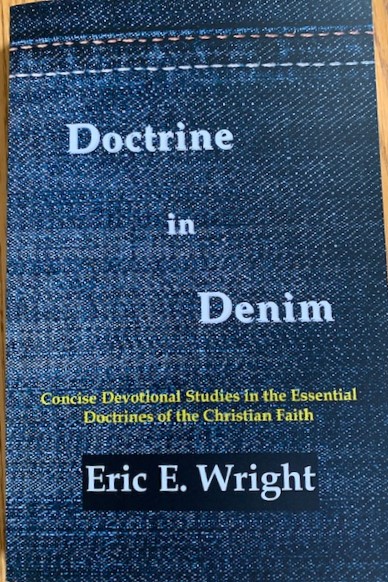
Get my new book Doctrine in Denim, Concise devotional studies on the Essential Doctrines of The Christian Faith. Truth to anchor our Faith in a time of Drift and Doubt. For personal devotions; small groups, or reference. As a paperback or ebook. Available wherever Amazon operates.

(Watch for a reprint of Down A Country Road from which this was taken. Let me know your thoughts on this subject. If you appreciate this blog, please pass it on. If I can help you spiritually, let me know. Further articles, books, and stories at:  Facebook: Eric E Wright Twitter: @EricEWright1 LinkedIn: Eric Wright ; Eric’s books are available at: https://www.amazon.com/Eric-E.-Wright/e/B00355HPKK%3Fref=dbs_a_mng_rwt_scns_share)


[1] See Matt. 1:22; 2:5,15,17; 3:3, etc.

[2] John Blanchard, Does God Believe In Atheists? Darlington: Evangelical Press, 2000, p. 409 Read Blanchard’s short, but excellent section on prophecy from page 407 to 410. For this specific prophecy compare 1 Kings 13:1,2 with 2 Kings 21:25 – 22:2; 23: 15-18

[3] Ibid, p. 409,410